Supported by


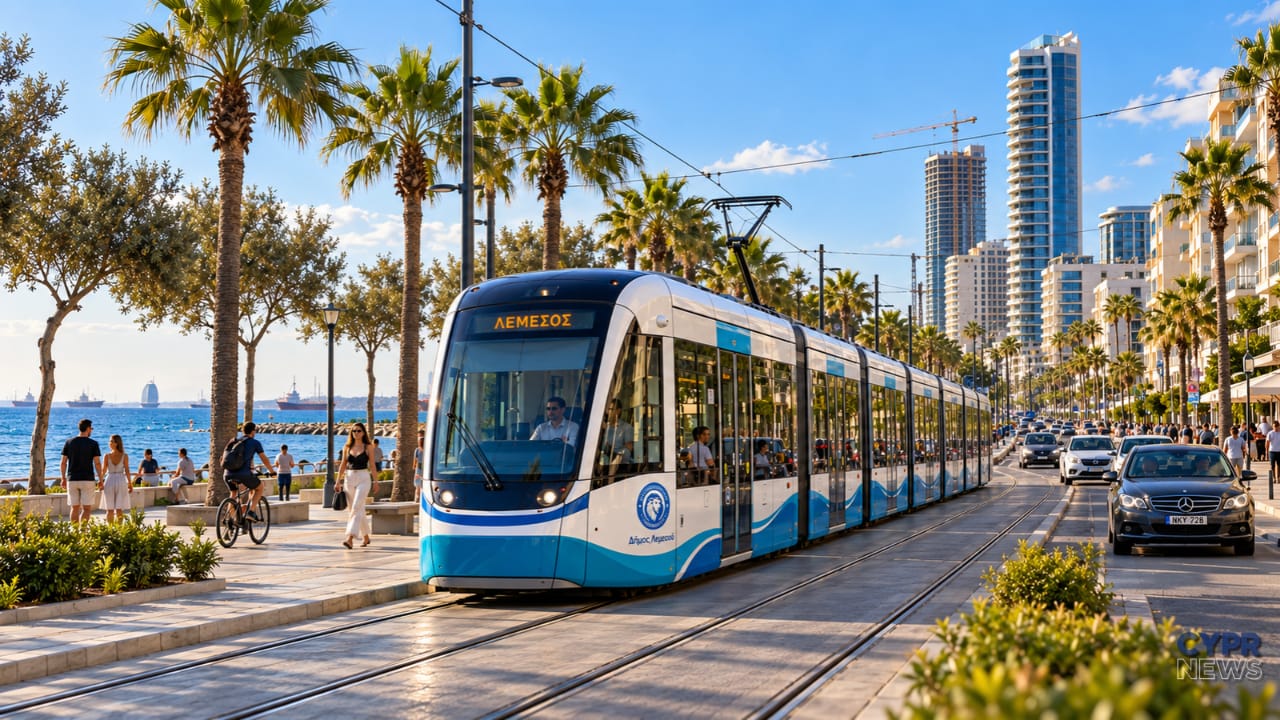
A tram in Limassol could connect the port, the city center, and the eastern part of the metropolitan area. Mayor Yiannis Armeftis presented two variants of the track layout being considered. Preliminary calculations indicate that building a 10-kilometer network would cost approximately €250 million, and a 20-kilometer one approximately €500 million.
The idea is being explored in conjunction with the local governments of Amathounta, Polemidia, and Kourion. However, a decision has not been made to implement the project. First, it must be determined whether residents would use the tram and whether its construction and subsequent maintenance would be justified.
The first option starts at Kolonakiou Street in Germasogei. It continues through Griva Digeni and Gladstonos, then along Aktaia Road towards the port, and ends at the Lady's Mile roundabout.
This connection would facilitate travel between the eastern part of the city, the city center, and the port area. The authorities want to accommodate both existing large investments and areas that are yet to be developed.
The second option connects the Ypsonas area and the Kourion commune with the coastal part of Amathounta. The route would pass through Pafou, Misiaouli, and Kavazoglou streets.
According to the mayor, the proposed layout would resemble the letter "X." Additional branches and connections would also be possible. However, at this stage, these are conceptual routes, not approved designs with designated stops.
Armeftis assumes an estimated cost of around €25 million per kilometer. At this rate, ten kilometers of track would represent an investment of around €250 million, and twenty kilometers around €500 million.
The mayor also points out that more advanced solutions could raise the cost per kilometer to €30–35 million. The final figure will depend on the length of the network, the technology chosen, and the scope of work.
The figures provided are not an approved budget. Neither a construction start date nor secured financing are provided.
Armeftis emphasizes that local governments want to first assess the project's profitability. The tram would reduce traffic congestion, improve travel conditions, and reduce environmental impacts, but these benefits must be weighed against the costs.
One of the most striking elements of the preliminary analysis is the potential increase in property values along the future routes. According to information provided by the mayor, the total additional value could reach €1.5 billion.
This forecast is dependent on the investment's implementation. It does not imply that this amount will flow into the city budget or guarantee an increase in the price of each apartment or plot.
Better access to public transport would increase the attractiveness of areas near the tracks. However, for residents, the most important practical question remains: would a tram allow for more efficient access to work, school, and the city center?
The mayor argues that the current bus service has not attracted the expected number of passengers, despite subsidies in Limassol amounting to around €25 million per year.
According to his assessment, buses account for approximately 2–3 percent of journeys, although he also cites higher estimates, reaching 4–5 percent. These are data presented by a local government official, not the results of the study published in this material.
The tram would be operated in conjunction with buses. These would continue to serve areas beyond the rail line and could transport passengers to tram stops.
We previously wrote about the proposal for the capital in CyprNews. Mayor Charalambos Prountzos presented a concept for a roughly 20-kilometer route, the construction of which was initially estimated at €500–600 million. Nicosia wants to update the previous study and include rail transport in discussions about the future of transport.
The mayors are also discussing the long-term idea of a rail link between Limassol and Nicosia. However, this is not a currently planned investment, nor is it part of the city's proposed tram network.
For Limassol, the next step is transportation and spatial analyses. According to Armeftis, the feasibility study is scheduled for completion in October, with an estimated cost of €600,000–1 million. Only the results will allow for a decision on whether the proposed options are worth pursuing.
Sources: Philenews, CyprNews.