Skip to content
Supported by


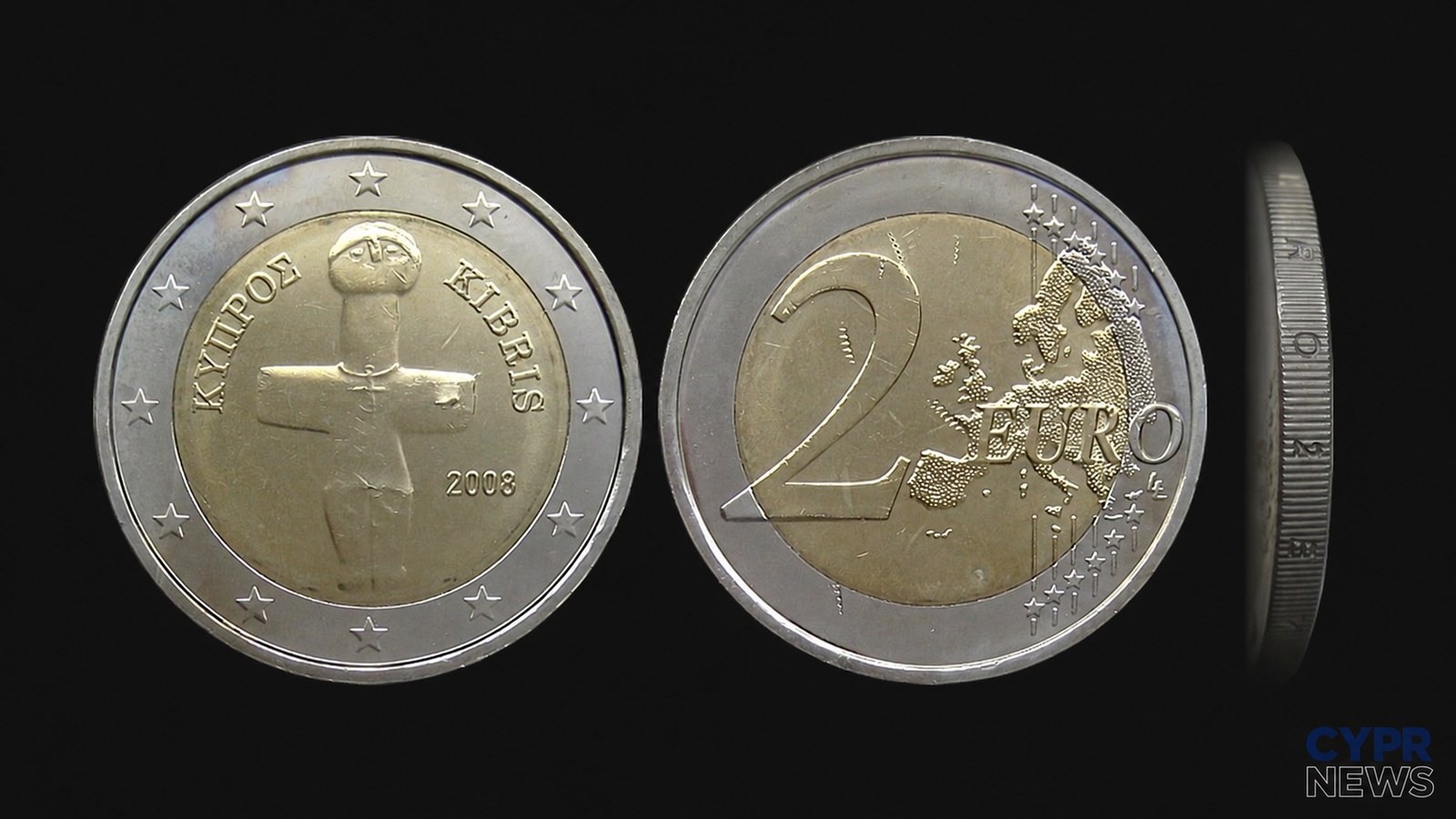
The inscription "KIBRIS" on Cypriot euro coins means "Cyprus" in Turkish. Next to it is the Greek "ΚΥΠΡΟΣ," the exact same name. The two inscriptions stem from the Constitution of the Republic of Cyprus, which establishes Greek and Turkish as official languages and explicitly stipulates the use of both languages on coins.
These are not coins from the occupied north, nor were they issued in conjunction with the local administration. These are coins from the Republic of Cyprus, a member of the eurozone since January 1, 2008. A small inscription recalls the state's bi-communal foundations, which have survived in its law despite the island's de facto division.
The national side of Cypriot euro coins features two names for the country: Greek ΚΥΠΡΟΣ and Turkish KIBRIS.
In Turkish the name of the island is written as KıbrısWhen written in capital letters, it takes the form KIBRISThe letters "I" here correspond to the Turkish "ı", a letter without a dot.
This isn't an abbreviation of a bank, mint, or part of an island. Both inscriptions represent the same country, presented in two official languages.
They can be found on regular circulation coins, regardless of their denomination and the motif on them.
The explanation is not limited to the general recognition of Turkish as an official language.
Article 3 of the Constitution of the Republic of Cyprus contains a separate provision regarding the use of both languages on coins, banknotes, and postage stamps. Bilingual designations on Cypriot coins therefore have a direct constitutional basis.
This principle was established in 1960, when the independent republic was established. The state was to be based on the participation of Greek and Turkish Cypriots, and its documents and symbols were to reflect both communities.
Joining the eurozone changed the currency. However, it did not abolish the constitutional status of the Turkish language.
Cypriot circulation coins are divided into three design groups.
On coins 1, 2 and 5 cents a Cypriot mouflon was presented. 10, 20 and 50 cents decorates the ship from Kyrenia, while on the coins 1 and 2 euros there is a prehistoric figurine known as the Pomos idol.
The motifs evoke the island's nature, maritime history, and ancient culture. They are connected by the country's names, written in Greek and Turkish.
The bilingual marking also appears on Cypriot commemorative coins. One example is the €2 coin commemorating the Republic of Cyprus's Presidency of the Council of the EU in the first half of 2026.
The intercommunal crisis of 1963–64 led to the breakdown of the cooperative functioning of key state institutions. Following the Turkish invasion in 1974, the northern part of the island fell beyond the effective control of the government of the Republic of Cyprus.
However, the constitutional principle that Greek and Turkish remain the official languages has not been repealed.
Therefore, the presence of Turkish on the coin does not constitute recognition of the self-proclaimed administration in the occupied north. The Turkish language is part of the political system of the Republic of Cyprus itself.
Similarly, Turkish Cypriots are not treated under the law of the republic as citizens of a foreign state simply because they speak Turkish.
A person living on an island may be surprised to find a Turkish inscription on an ordinary coin, but not the English "CYPRUS".
English is widely spoken in tourism, business, banking, and dealing with foreigners. Many government websites also provide English versions of information.
However, this does not grant it the status of an official language of the Republic of Cyprus. The constitution lists Greek and Turkish as its languages.
The English name of the country may appear on select collector issues. However, standard circulation coins feature two names corresponding to the country's official languages.
This is another detail that is easy to miss.
Turkish is an official language of the Republic of Cyprus, but it is not among the 24 official languages of the European Union. Of Cyprus's two official languages, Greek has such status in EU institutions.
Membership of a country in the EU does not automatically mean that each of its official languages becomes an official language of the entire Union.
This also does not change citizenship: Turkish Cypriots with citizenship of the Republic of Cyprus are EU citizens. However, simply residing in the north of the island does not automatically confer EU citizenship.
Cypriot euro coins can be spent throughout the eurozone. Their Turkish inscription does not limit the currency's validity or indicate on which side of the Green Line it should be used.
In the occupied north, the Turkish lira remains the primary currency. The fact that shops or restaurants there accept the euro does not make the north a separate issuer of the common European currency.
"KΚΥΠΡΟΣ" and "KIBRIS" are two names for the same island. This small coin preserves the principles upon which the Republic of Cyprus was established in 1960.