Supported by


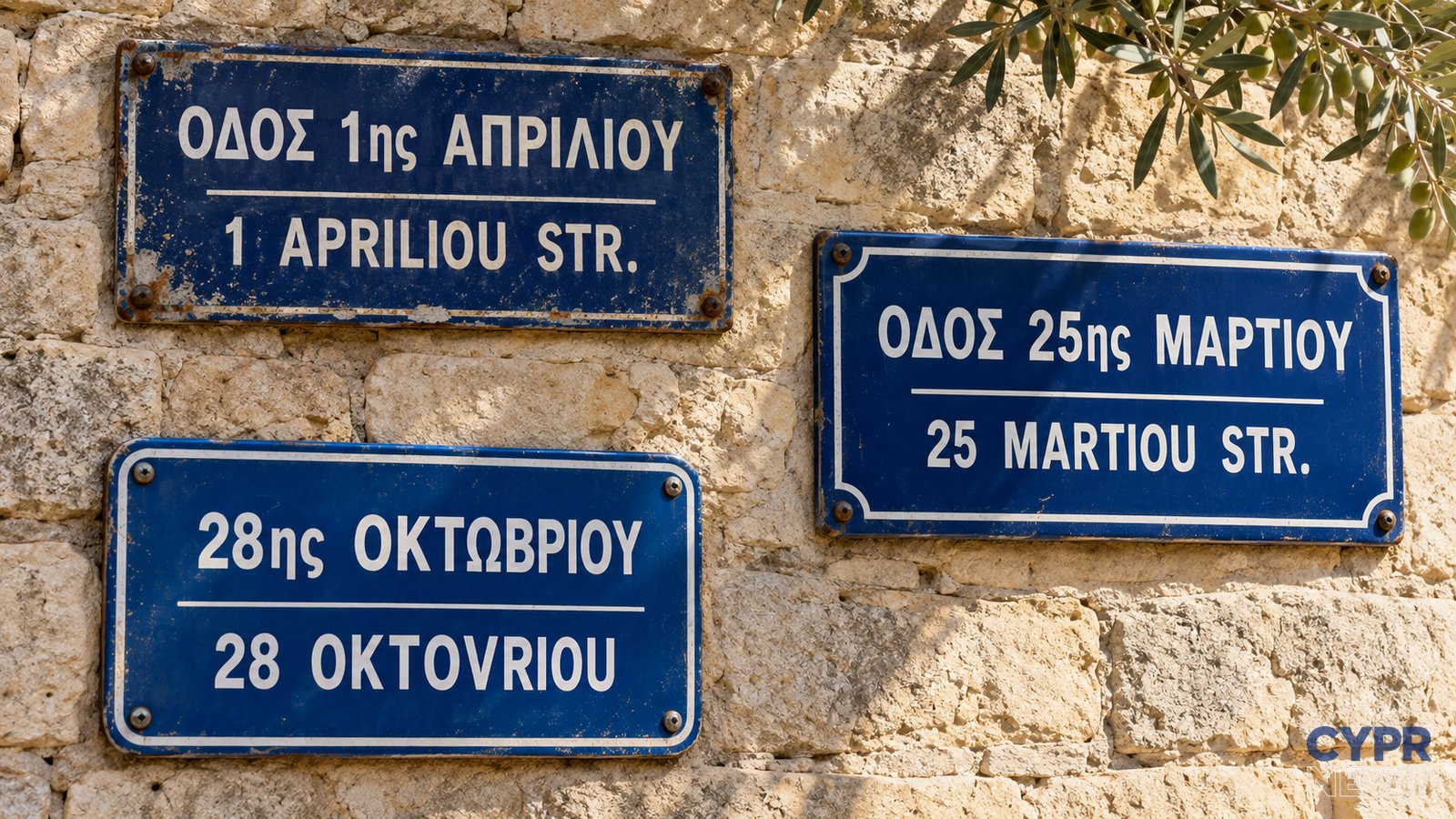
Street names in Cyprus can look like calendar pages. 1 Apriliou, 25 Martiou, and 28 Oktovriou commemorate historical events: the start of the EOKA struggle, the Greek independence uprising, and the rejection of the Italian ultimatum in 1940.
The same is true of the names on the plaques. Makariou recalls the first president of the Republic of Cyprus, and Griva Digeni recalls the EOKA commander Georgios Grivas. However, beware of the similarities: Digeni Akrita refers to a legendary Byzantine hero. A few letters can transport us from the 20th century to a medieval tale.
Makarios and Makariou are not two different people. The change in ending is due to the Greek declension: the full name means "Makarios' avenue" or "street."
Similarly, Grivas becomes Griva, and Agios Andreas becomes Agiou Andreou, or "of Saint Andrew." Date names also include forms meaning "April," "March," and "October."
An additional difficulty is the use of the Latin alphabet. The board may have Oktovriou, and on the map Octovriou.Makarios Avenue is also known as Makarios Avenue or Archbishop Makarios III Avenue.
This is why the name read on the signpost does not always look identical to the one in the hotel booking confirmation.
April 1st Street commemorates the beginning of the EOKA military campaign in 1955. The organization sought to end British colonial rule and unite Cyprus with Greece, i.e. enosis.
Fighting continued until 1959. However, the political outcome was not the island's annexation to Greece. Instead, an independent Republic of Cyprus was established.
It is worth separating these dates: On April 1, 1955, the EOKA campaign began, and on August 16, 1960, Cyprus gained independence.The official Independence Day is celebrated on October 1.
One street name can lead to a story that includes as many as three important days.
March 25 is the symbolic date of the beginning of the Greek uprising against the Ottoman Empire in 1821. Years of fighting led to the creation of an independent Greek state.
On the same day, the Annunciation of the Mother of God is celebrated. The anniversary therefore has both national and religious dimensions.
Its presence in Cypriot public spaces stems from Greek Cypriots' ties to Greek culture, language, and Orthodoxy. The name 25 Martiou recalls Greek history, which remains an important element of the community's identity.
On October 28, 1940, Greece rejected an Italian ultimatum demanding that its troops be allowed to occupy strategic points on its territory. That same day, the Italian attack from Albania began.
We know the anniversary as Ochi Day or Ohi Day, or "No" Day. Greek ochi means precisely refusal.
This name should not be treated as a verbatim quotation limited to a single word. "No" has become a symbol of rejection of an ultimatum and resistance to aggression.
On the Cypriot plaque, 28 Oktovriou therefore marks a specific historical anniversary.
The avenues and streets of Makariou commemorate Archbishop Makarios III. He combined the duties of head of the Church of Cyprus with the office of the first President of the Republic of Cyprus.
He was president from 1960 to 1977, with a break caused by the 1974 coup.
The full name of the artery may be Leoforos Archiepiskopou Makariou III, or the avenue of Archbishop Makarios III. The character Γ΄ found in the Greek script corresponds to the Roman III. It is part of the hierarch's name, not a street number.
In everyday conversation, the long name is usually shortened to just Makariou.
Griva Digeni refers to Georgios Grivas, a Cypriot-born Greek army officer and commander of EOKA. Digenis was his pseudonym.
His name is associated with the anti-colonial struggle, but also with the later activities of EOKA B—an organization seeking to unite Cyprus with Greece and opposing Makarios. Therefore, Grivas's assessment remains controversial.
Digeni Akrita commemorates the hero of a medieval Byzantine epic. Digenis Akritas was a legendary frontier warrior, the son of an Arab emir and the daughter of a Byzantine commander.
The similarity of the names has its explanation, but the patrons of the streets are two different figures: a real commander from the 20th century and a hero of literature and folklore.
Not every street name is associated with political events. Many streets commemorate saints and are associated with a nearby church or chapel.
Agiou Andreou means "Saint Andrew", Agiou Georgiou — "Saint George", and Agias Elenis — "Saint Helena".
On the other hand Eleftheria it's freedom. That's why Plateia Eleftherias means Freedom Square. The word plateia indicates the square, odos street, and Leophorus avenue or major artery.
A few words like these make it easier to understand the address, even without being able to read Greek fluently.
The names described are characteristic primarily of towns in areas controlled by the Republic of Cyprus. They reflect important events and figures in Greek Cypriot historical memory.
For the visitor, they initially appear as a series of difficult words typed into a navigation system. Once deciphered, they begin to speak of independence, religion, ties to Greece, and political disputes.
So, next time you take a walk, it's worth checking out the plaque above the intersection. Perhaps you're standing on a street named after an event whose anniversary is commemorated annually by local residents.