Supported by


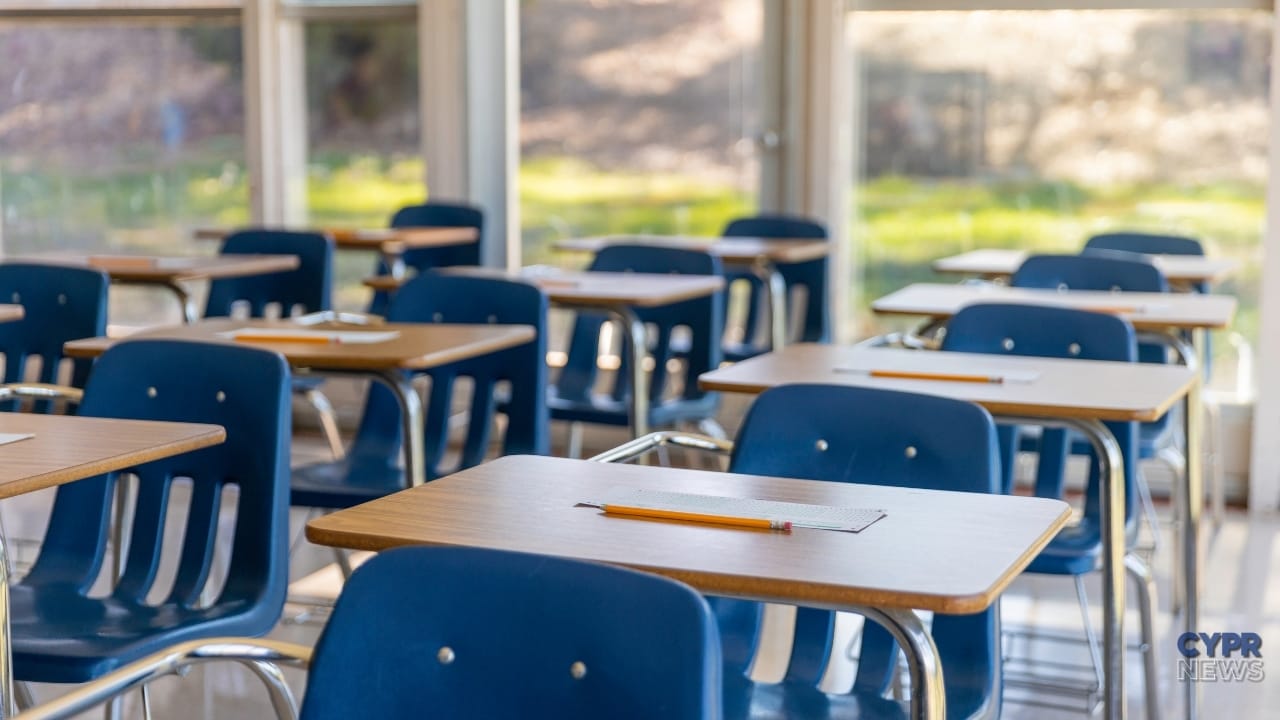
Schools in Cyprus have begun the 2026/2027 school year amid several serious challenges. Some textbooks for primary school students will not arrive until mid-October, and OELMEK is warning that many classrooms still lack air conditioning. Simultaneously, the PISA 2025 results were released, showing Cypriot 15-year-olds remaining significantly below the OECD average.
Most concerning is the percentage of students who fail to achieve basic proficiency in both science, reading comprehension, and mathematics. In Cyprus, the figure was 43.5%, compared to the OECD average of 19.7%. The Ministry of Education acknowledges that further reforms are needed.
According to information provided to school principals by the Ministry of Education, the delivery of some textbooks to primary schools will only be completed around mid-October 2026.
This means that for the first few weeks of the school year, students and teachers will complete part of the curriculum without printed books.
Until then, teachers are to use electronic materials, student notebooks, worksheets, and other available resources. The Ministry also recommends using printed materials sparingly.
Delays affect six teaching areas:
In the case of mathematics, the delivery of the first batch of textbooks for grades 1, 2, 3, 4, and 6 has been delayed. Shorter workbooks covering the material for the first few weeks of school are expected to arrive in schools around mid-September.
The first-grade class also lacks a textbook for natural sciences and technology. Until it arrives, teachers are instructed to use the available set of exercises and practical tasks.
Fourth-grade students will temporarily use an electronic version of the Cypriot history textbook. Third-grade students have not yet received the "Geography" textbook "Getting to Know My World," so lessons will be conducted using online materials and worksheets.
Textbooks on digital design and technology for grades 5 and 6 are also delayed. The Ministry is pointing to digital books, presentations, videos, software, and materials for teachers.
Students of grades I, II, III, IV and VI are waiting for religion textbooks.
The Ministry assures that despite the delays, lessons will continue as scheduled. These temporary measures will remain in place until the correct books are delivered.
This explanation did not convince the Pan-Cyprian Organization of Greek Teachers – POED.
The organization's president, Myria Vasiliou, emphasized that students should receive textbooks from the first day of school. She believes it is unacceptable to begin the year using photocopies and makeshift materials.
POED also notes the additional use of paper and resources. The organization believes that the one-month delay cannot be dismissed as a minor technical issue.
Missing textbooks are not the only problem schools in Cyprus are currently facing.
OELMEK, an organization representing secondary school teachers, reports that despite earlier announcements, many institutions still have classrooms without air conditioning.
With persistently high temperatures, students and teachers spend many hours indoors where conditions can cause severe heat stress.
OELMEK emphasizes that this isn't just a matter of comfort. It's also about health, safety, and providing appropriate learning and working conditions.
The organization accuses the Ministry of Education of delays in implementing the announced measures. However, it did not provide an exact number of schools or classrooms where air conditioning has not yet been installed.
The organizational problems coincided with the publication of the PISA 2025 results. The study tests the skills of fifteen-year-old students in natural sciences, reading comprehension, and mathematics.
The performance of Cypriot students remains significantly lower than the OECD average:
Compared to the 2022 examination, the result in natural sciences remained at 411 points.
In reading comprehension, there was a drop of two units – from 381 to 379 points – but the change was not considered statistically significant.
In mathematics, the score dropped from 419 to 412. This seven-point drop was considered statistically significant.
A comparison with Poland further highlights the scale of the difference. Polish 15-year-olds scored above the OECD average in all three core PISA domains, while Cypriot students' scores remained significantly below this level.
The largest difference between Poland and Cyprus is in reading comprehension, at 103 points. In natural sciences, Poland leads Cyprus by 84 points, in numerical problem solving by 80 points, and in mathematics by 72 points.
Particularly disturbing is the result of students who simultaneously failed to achieve a basic level of skills in any of the three main areas.
In Cyprus this group includes 43.5% of fifteen-year-oldsThe OECD average was 19.7%.
At the same time, only 4.6% of Cypriot students achieved high scores in at least one of the measured areas. The average across OECD countries was 11.9%.
This means that the problem affects both a large group of students struggling with basic skills and a relatively small number of high achievers.
However, not all data is negative.
In Cyprus, socioeconomic background explains 6.6% of the variance in science achievement. Across OECD countries, the average was 11.6%.
The gap between students from more and less advantaged backgrounds is also smaller. In Cyprus, the gap is 73 points, compared to the OECD average of 85 points.
Additionally, 15% of students from disadvantaged backgrounds were classified as "educational resilient." These students achieve well despite their more difficult social and economic circumstances. The OECD average in this category was 11.9%.
Education Minister Athena Michaelidou admitted that the PISA results confirm the need for serious changes in the education system.
The Ministry also points to stabilization of results in natural sciences and reading comprehension, as well as more favorable data for students from less privileged backgrounds.
According to the minister, the ministry has prepared an action plan together with PISA experts, and the results are to be further analyzed in comparison with other European countries and previous editions of the study.
However, the start of the school year demonstrates that schools in Cyprus are simultaneously grappling with long-term challenges and very basic organizational difficulties. Reforming the curriculum and teaching methods will have limited impact if students are left without books for weeks and some lessons are held in overheated classrooms.
Sources: Ministry of Education of the Republic of Cyprus, POED, OELMEK, philenews, Politis, PISA 2025