Supported by


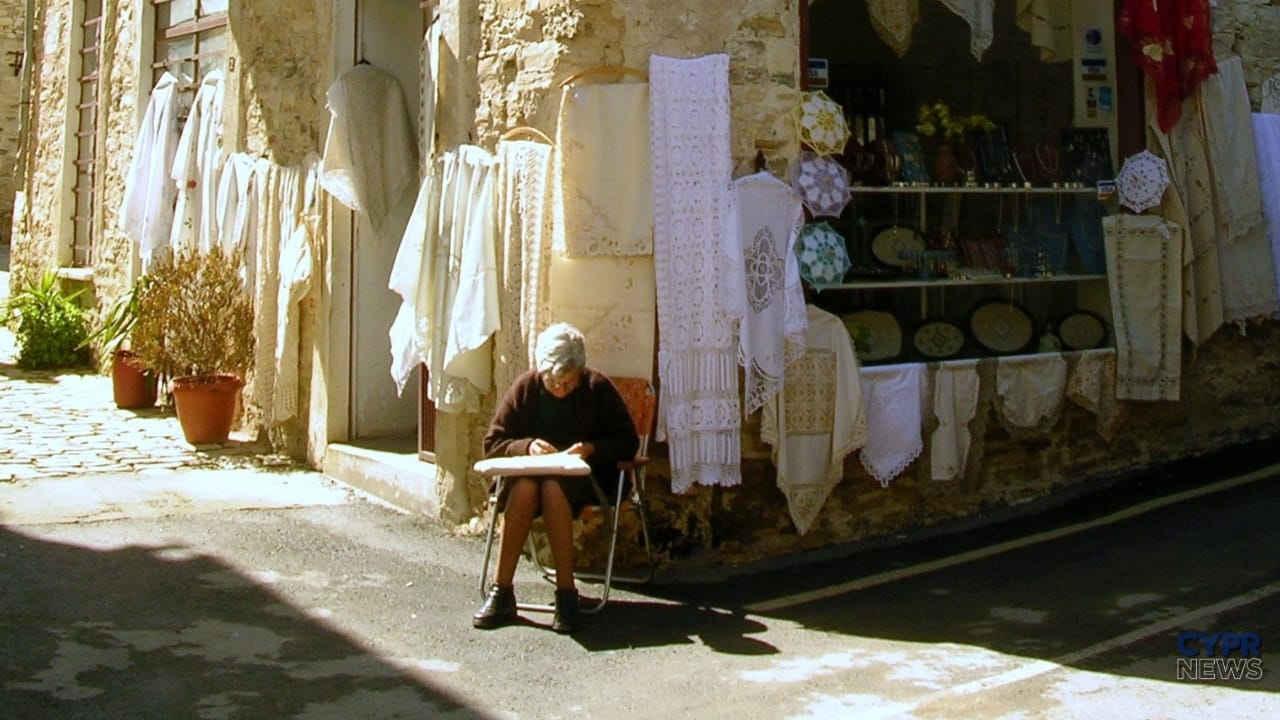
Lefkaritika This distinctive lace is handmade in Lefkara. Its tradition dates back to at least the 14th century, and in 2009 it was inscribed on UNESCO's Representative List of the Intangible Cultural Heritage of Humanity, the first Cypriot item to be added to this list.
Lefkaritika is also the site of one of the most famous local stories. Legend has it that Leonardo da Vinci visited Lefkara in 1481, bought an embroidered altar cloth, and donated it to the Milan Cathedral. The story is compelling, but modern research has found no evidence that this actually happened.
UNESCO dates the lace-making tradition in Lefkara to at least the 14th century.
The art developed over the following centuries, combining local techniques with geometric patterns derived from Greek and Byzantine traditions and influenced by embroidery from the period of Venetian rule in Cyprus.
However, this wasn't simply a copying of foreign designs. The inhabitants of Lefkara created their own, easily recognizable style.
It was from the place of origin that the lace got its name Lefkaritika – λευκαρίτικα.
Lefkaritika are traditionally made from linen fabric. UNESCO lists four basic elements of this technique: hemstitching, cutting out fabric fragments, filling with embroidery, and needle-stitching.
Some of the thread is carefully pulled from the fabric. The remaining fibers are then joined using precise stitches to create geometric compositions.
Some fragments resemble small lattices. Others are arranged in rhombuses, zigzags, crosses, and repeating stripes.
One of the most famous motifs is Potato, meaning "river" - a geometric pattern running along the fabric.
The larger the work and the more complex the composition, the more time it takes to complete. A large tablecloth can require many months of work.
Lefkaritika weren't just a commodity for sale. For generations, they were part of the daily lives of local women.
UNESCO describes embroiderers meeting at work in the narrow streets of Lefkara or in covered courtyards. While embroidering, they chatted, exchanged experiences, and passed on their knowledge to younger generations.
The girls watched their mothers and grandmothers. Over time, they learned basic stitches and later knitted increasingly difficult patterns.
There was no single manual containing all the rules. Observation, practice, and years of experience were paramount.
Lefkaritika have specific techniques and characteristic motifs, but a good lace maker was not just a maker of a ready-made pattern.
After mastering the basics, she was able to create her own compositions. The work still belonged to the Lefkaritika tradition, but at the same time bore the imprint of a specific artist.
This explains why old lace can vary significantly in detail. They are similar in technique and style, but not necessarily identical.
According to a story repeated in Lefkara, Leonardo da Vinci was said to have visited the town in 1481.
The artist was said to have been fascinated by local handicrafts, to have purchased an embroidered altar cloth and then to have donated it to the cathedral in Milan.
The story can be found in materials from the Lefkara Municipality and Visit Cyprus. Importantly, the official tourism portal presents it as legend, not a documented historical fact.
Over the years, however, the story became so popular that it was often repeated without this caveat.
Historian and diplomat Robert Merrillees has analyzed in detail the story of Leonardo's journey.
He found no reliable source confirming that the artist visited Cyprus in 1481. There is also no historical evidence that he bought lace in Lefkara or donated a Cypriot tablecloth to the cathedral in Milan.
The researcher also noted that the story began to be widely disseminated relatively late, primarily in the 20th century. It was later repeated in guidebooks and tourist publications, gradually gaining the status of an almost certain event.
It was this detail that may have contributed to the creation of the entire story.
Leonardo da Vinci knew Cyprus, at least from the accounts of others and from available sources. His writings include references to the island.
However, mere knowledge of Cyprus is not proof of a personal journey.
Over time, someone was able to connect two true stories: Leonardo was interested in Cyprus, and Lefkara was famous for its embroidery. Then, the artist's visit and the purchase of the tablecloth were added to the story.
This last element could not be confirmed.
Regardless of the lack of historical evidence, the story of Leonardo has become a huge success and has itself become part of Lefkara's contemporary identity.
IN 1981, on the 500th anniversary of the artist's alleged visit, the Republic of Cyprus issued a series of postage stamps referring to Leonardo da Vinci, Milan Cathedral and Lefkaritika.
A few years later, something now fully documented happened.
IN 1986, during the celebration of the 600th anniversary of the Cathedral of Milan, a delegation from Lefkara presented the temple with a new tablecloth made by local embroiderers.
So this wasn't a tablecloth purchased by Leonardo. It was a contemporary gift that symbolically referenced a well-known legend.
In 2009, Lefkaritika was inscribed on the UNESCO Representative List of the Intangible Cultural Heritage of Humanity.
This was the first Cypriot item to be included on the list. Two years later, it was joined by Tsiattista, i.e. traditional Cypriot duels with improvised rhymes.
UNESCO recognized not only the final appearance of the lace, but also the skills of local women, the transfer of knowledge between generations, and the social dimension of collaborative work.
In the shops in Lefkara you can find both authentic handicrafts and cheaper products that only resemble local traditions.
Before purchasing, it's worth examining the material and details. Hand-made lace won't look as perfect and mechanical as a machine-made pattern. Slight differences between individual pieces may indicate that the lace was indeed hand-made.
Price is also a factor. Creating an intricate tablecloth requires weeks or even months of work, so authentic Lefkaritika cannot cost as much as a mass-produced souvenir.
It is best to ask the seller who made the work, what material it was made of and whether you can see its left side.
Even if Leonardo da Vinci had never set foot on Cyprus, the Lefkaritika would have lost nothing.
UNESCO did not include them on its list because of the Renaissance artist. Instead, they valued the centuries-old technique, the skill of women, the transmission of knowledge between generations, and the ability of the local community to create its own style.
The legend of Leonardo remains an attractive part of the Lefkara story. However, it should not be presented as a confirmed historical event.
The true story of Lefkaritika is remarkable enough without the famous name.
All you need is a needle, linen and hundreds of years of work by the women of Lefkara.
The material was prepared based on information from UNESCO, the Cyprus National Commission for UNESCO, the Municipality of Lefkara, Visit Cyprus and the publications of historian Robert Merrillees