Supported by


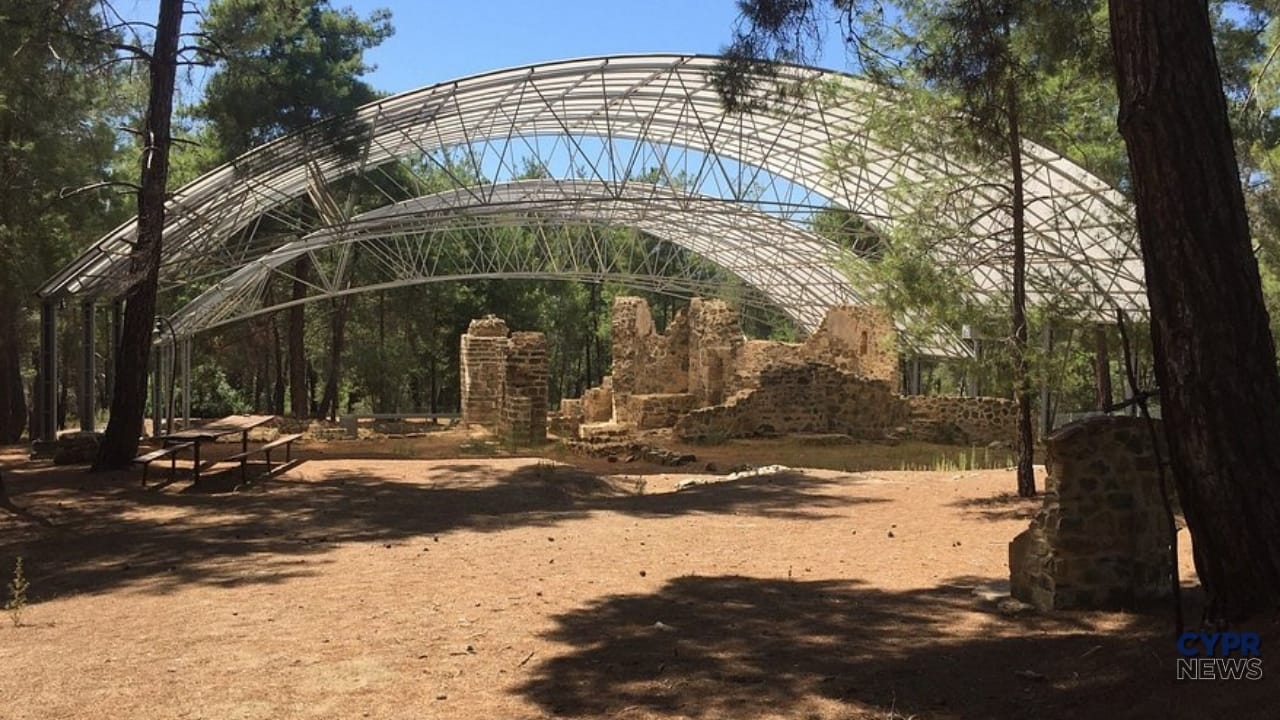
A Georgian monastery in Cyprus might sound like something you wouldn't expect to find in the middle of a Paphos forest. Yet, about five kilometers east of the village of Gialia lie the ruins of the medieval monastery of Panagia Chrysogialiotissa, known in Georgian sources as Ghalia or Zhalia.
The first Georgian monks arrived here in the second half of the 10th century. The monastery became a religious, educational, and cultural center, where books were transcribed and texts translated from Greek into Georgian. After its abandonment, the site almost disappeared from memory. The ruins were only rediscovered in 1981.
In the Middle Ages, contacts between the Christian communities of the eastern Mediterranean were much more intense than modern borders suggest.
Georgian monks also founded monasteries outside their own country. These centers served more than just prayer. They also copied books, translated texts, and maintained contacts with other centers of Christianity.
According to the Cypriot Department of Antiquities, the monastery of Gialia was founded on the initiative of David III Kuropalates, ruler of Tao-Klarjeti. Visit Paphos indicates the period between 970 and 979, while archaeologists date the foundation of the complex more broadly – to the second half of the 10th century.
This means that the history of the monastery dates back over a thousand years.
Today's stone remains may look modest, but in the Middle Ages an extensive and wealthy monastery operated here.
It was under the care of successive Georgian rulers. The king played a special role in its development. David IV the Builder and the queen Tamar, one of the most important figures in the history of medieval Georgia.
Visit Paphos describes Gialia as one of the wealthiest monasteries operating on the island at the time. Medieval records indicate an annual income of around 300 ducats.
Archaeological discoveries also attest to the wealth of the place. Among other things, excavations yielded:
One of the most important functions of the monastery was intellectual activity.
From the 10th to the 15th centuries, a center for copying manuscripts operated here. New copies of books were created, and texts were translated from Greek into Georgian.
In the pre-printing era, preparing a single book required an enormous amount of labor. The text had to be hand-copied, proofread, and properly bound. Depending on the size of the work, the process could take months.
In a place that today looks like quiet ruins hidden in the forest, there functioned a center participating in the international circulation of knowledge in the medieval world.
The most important building in the complex was a domed church with three apses.
The Department of Antiquities describes it as the only structure of its kind discovered in Cyprus. Similar architectural solutions are known from Georgia, particularly from the historical region of Tao-Klarjeti.
However, the temple's construction technique was local. Archaeologists interpret this as evidence of cooperation between Georgian monks and Cypriot builders.
The architecture thus combined two worlds: the Georgian concept of the temple and local knowledge of materials and methods of construction.
The interior of the main church was richly decorated.
The southern apse contained a scene of the Baptism of Christ, while the northern apse featured the Descent from the Cross. Depictions of saints and fragments of a painted iconostasis were also discovered.
The main layer of paintings dates from the 12th century and represents the art of the Comnenian period.
A chapel dedicated to St. George was added to the north side of the main temple. A Georgian inscription and a depiction of the warrior saint were found within it.
These are material evidence of the presence of Georgian monks. The site was not recognized as Georgian solely on the basis of later legend or architectural similarities.
Archaeological research has shown that the complex included much more than one church.
Among other things, the following were discovered:
The monastery had to provide its inhabitants with water, food, shelter, and a workplace. It also needed rooms for storing books, conducting services, and burying deceased monks.
Today's fragments of walls are the remains of a much larger and well-organized world.
Georgian monks remained in Gialia until at least the 14th century. After that, mentions in Georgian sources become increasingly rare.
However, archaeological finds show that parts of the complex were also used in the 15th and 16th centuries. Graves and artifacts dating from this period have been discovered.
The monastery's final abandonment is dated to the second half or late 16th century. Visit Pafos attributes its decline to subsequent destruction and the situation following the Ottoman conquest of Cyprus in 1571.
The unused buildings gradually fell into ruin and the area was taken over by the forest.
Medieval Georgian sources mentioned a monastery called Ghalia or Zhalia. However, the exact location of the center was uncertain.
The turning point came in 1981. Georgian art historian Vakhtang Djobadze, affiliated with California State University, Los Angeles, identified remains in a forest about five kilometers east of Gialia as a monastery known from medieval records.
This doesn't mean that no one had seen the stone ruins before. The most important thing was recognizing their historical identity and connecting the remains with Georgian sources.
It was necessary to wait another 25 years for systematic research.
Regular archaeological work began in 2006 as a joint venture between Cyprus and Georgia.
The research was conducted in collaboration with the Cyprus Department of Antiquities. In subsequent seasons, temples, utility rooms, graves, cisterns, and remains of decorative elements were uncovered.
Thanks to the excavations, it was possible to confirm the chronology of the complex, study its unusual architecture, and better understand the significance of Gialia for medieval Georgian culture.
The ruins lie in the Paphos Forest, about five kilometers east of the village of Gialia. The nearest larger town is Polis Chrysochous.
The site is located off the main tourist routes. Before setting off, it's worth checking the route and its current condition, especially after heavy rainfall. Cell phone reception may be weaker in the forested sections, so it's a good idea to map out your route in advance.
When on site, please move carefully and avoid stepping on any preserved wall fragments. Do not take any stones, pottery fragments, or any other objects found on the site.
A Georgian monastery in Cyprus is a reminder that the medieval island was a meeting place for many communities.
Greeks, Latins, Maronites, Armenians, Syrians, and Georgians, among others, lived and worked here. Its location between Europe, Asia Minor, and the Levant favored trade, pilgrimage, and the exchange of knowledge.
Gialia is one of the most material traces of this world.
More than a thousand years ago, monks prayed here beneath frescoes, scribes copied books, Georgian rulers financed reconstructions, and local craftsmen built temples according to plans brought from the distant Tao-Klarjeti region.
Later the complex was abandoned and almost disappeared from memory.
Today it remains one of those places that show that even after many years of living on the island, you can discover a completely unknown chapter of its history.
Sources: Department of Antiquities of the Republic of Cyprus, Pafos Regional Board of Tourism – Visit Pafos.