Skip to content
Supported by


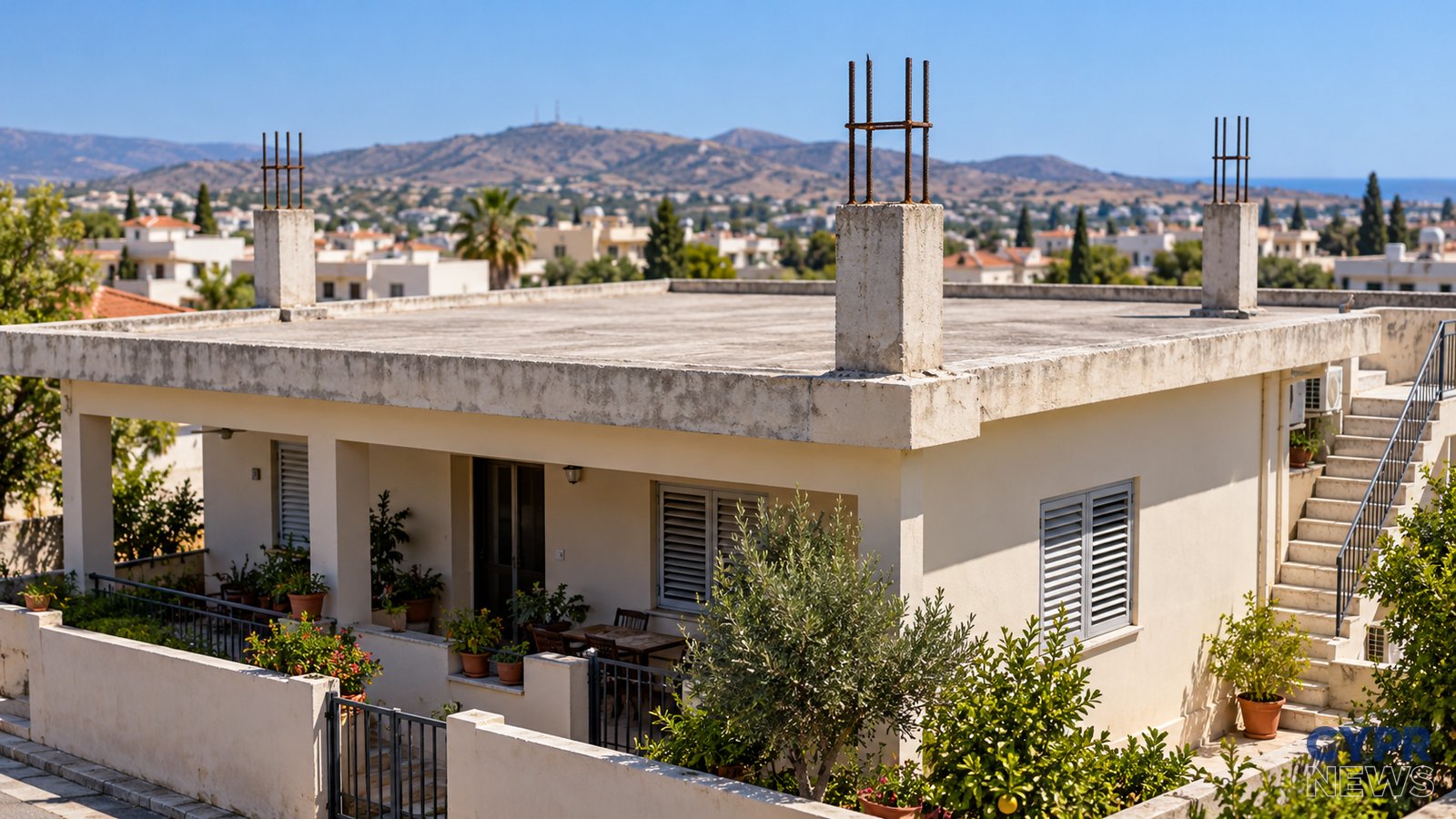
In Cyprus, the rebar on roofs was most often left in place for the purpose of adding another floor. A family would finish the ground floor and move in, postponing further construction until they had saved up money or the children were independent. The protruding rebar was intended to allow for the connection of the existing structure with the next floor.
Another common explanation is that the roof trusses meant the house was considered unfinished and tax was not payable. However, there is no confirmation of the simple rule "roof trusses mean exemption." Furthermore, state property tax was abolished in Cyprus on January 1, 2017.
Metal elements protruding from concrete columns are usually reinforcement left for future connection of the structure.
The house didn't have to be built to its final height immediately. The owner built the portion needed for living, reserving the option of expanding it later.
This solution allowed for spreading the costs over time. Instead of financing the entire building at once, the family completed the ground floor and planned the next floor only when savings permitted.
However, not every visible rod indicates a well-prepared project. Sometimes it's a remnant of interrupted work or a plan that was never implemented.
One of the reasons for leaving room for expansion was to provide housing for the next generation.
Parents stayed on the ground floor, and a separate apartment could be built above them for their adult daughter or son. There was no need to purchase another plot of land, and relatives remained nearby.
This arrangement facilitated shared childcare and assistance to older family members. At the same time, it allowed for separate households.
Plans didn't always come to fruition. Children chose another city, moved abroad, or simply didn't want to live above their parents. As a result, the reinforcement remained on the roof much longer than initially anticipated.
According to a repeated story, it was enough to leave the reinforcement in place for the inhabited house to continue to be listed as a building and not subject to taxation.
Such a mechanism should not be presented as a confirmed Cypriot tax principle.
Three issues must be distinguished: the actual condition of the building, its registration, and the method of calculating the specific tax. Visible bars do not determine any of these.
The former state property tax was based on the owner's property value based on historical valuation. It was not a tax assessed based on roof inspection.
Outdated documentation could have caused discrepancies between the actual state and official records. However, this does not prove that leaving the bars provided legal exemption or that taxes were the reason for leaving them.
The Cyprus Tax Department confirms that the state property tax has been abolished from January 1, 2017.
This doesn't mean that homeowners no longer face any burdens. Local fees and charges for property-related services may still apply.
However, today's rods cannot be explained by automatic avoidance of a tax that the state has not collected for years.
For some buildings, the simplest explanation remains the most likely: the rods were waiting for the next floor, and the floor was never built.
A finished kitchen, windows and working air conditioning do not tell the whole story about property documentation.
A building may have been in use for years and yet require clarification of discrepancies between the work performed, the approved design and the records in the Cadastre.
The Cypriot building registration procedure requires the submission of, among other things, permits, approved plans and an appropriate certificate of the work carried out.
Therefore, the appearance of a home shouldn't be equated with the completion of all procedures. The opposite also applies: the bars themselves don't prove that the owner has untidy documents.
The owner cannot assume that because the previous generation left the bars, the addition of a second floor is already approved.
Expansion requires review of current planning conditions, documentation, and required permits. The family's needs and the planned use of the building may also have changed.
Construction is a separate issue. Foundations, columns, and ceilings must be capable of supporting the additional loads.
The rods are merely a possible connection point. They do not constitute proof that the entire house was designed and constructed for the next floor.
Exposed reinforcement is exposed to moisture and weathering and can corrode over time, especially in coastal environments.
Not all surface rust poses a threat to the entire building. However, before using old rods, it's important to assess their condition and the connection to the existing structure.
It's not enough to simply clean them visually and pour new concrete. The scope of work required should be determined by a structural engineer.
Cypriot institutions remind that exposed reinforcement, cracks and concrete debonding are among the signs that require attention when assessing the condition of a building.
The protruding bars may look like an unfinished building, even though ordinary family life has been going on beneath them for decades.
They often reflect a practical plan: first an apartment for the parents, then a second floor for the children. Sometimes the plan was stalled by money, sometimes family needs changed.
Therefore, just by looking at the roof, we can't determine taxes, the legality of the building, or its load-bearing capacity. However, we can see a distinctive way of thinking about home—as a place intended to grow with the family.