Supported by


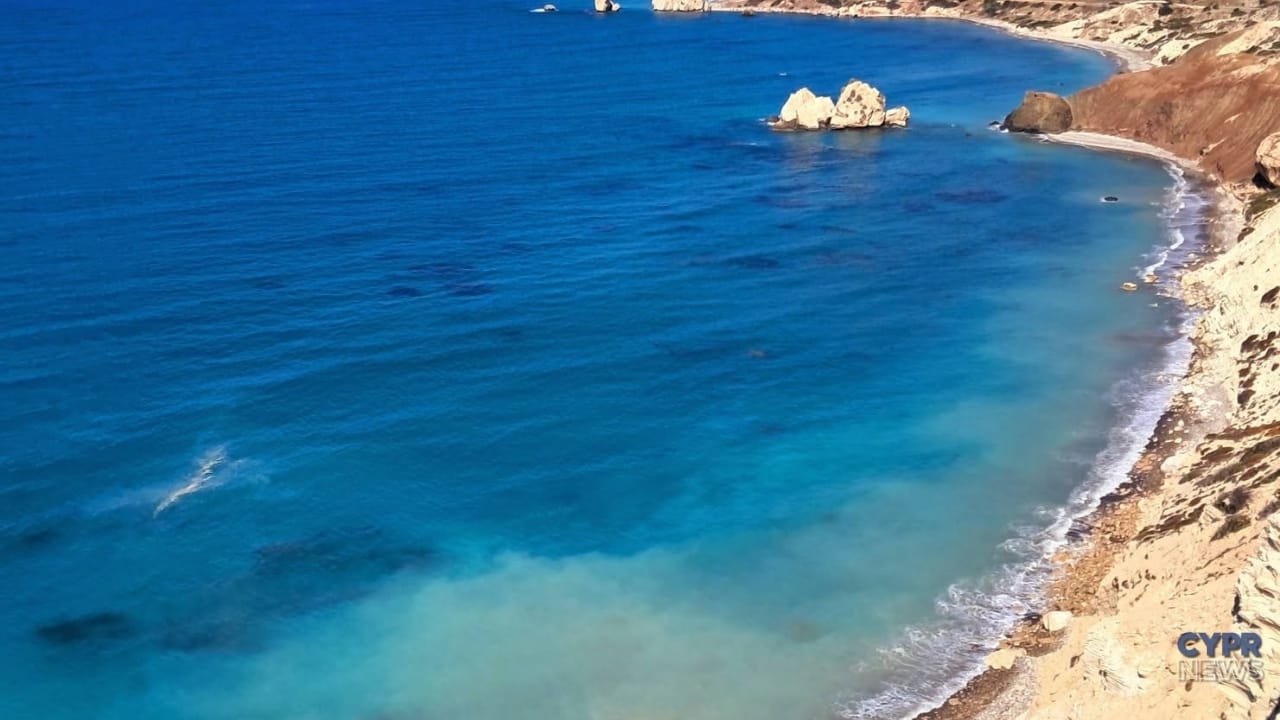
Cypriot environmental activist Andreas Evlavis published photos from Petra tou Romiou, claiming the substance visible is sewage. The photos are said to be from September 7th. The case concerns one of the island's most recognizable landmarks and an officially monitored bathing area.
However, there is currently no confirmation from the relevant authorities that the photographed material was indeed sewage. Its composition, source, or water test results have not been disclosed. To resolve the matter, an on-site inspection is necessary, and—if the substance reached the sea—samples must be collected for laboratory analysis.
Andreas Evlavis posted on social media photos taken in the Petra tou Romiou area, also known as Aphrodite's Rock.
In a short comment, he wrote that sewage had even appeared in this place, and the visible material is in the second of the published photos.
The photographs were subsequently featured in Cypriot media. They are noteworthy for their recognizability and importance to tourism and the natural environment.
However, photographic material alone does not allow us to determine the exact nature of the photographed substance. Based on its appearance, it is impossible to determine whether it is municipal sewage, contaminated water, sediment, surface runoff, or a material of another origin.
It is also not possible to determine whether the sea was contaminated and whether there was a threat to people on the beach.
The significance of the notification is enhanced by the fact that Petra tou Romiou is included in the official list of Cypriot bathing water areas.
The swimming area is marked with a code CY0006100000000118 and assigned to the town of Kouklia in the Paphos district. The Cyprus Department of Environment is responsible for the bathing water quality monitoring system.
Official monitoring of a site means that water quality is monitored during the season. However, this does not necessarily indicate the situation on a specific day and does not replace an investigation conducted after a potential incident is reported.
Even very good early results cannot confirm that temporary contamination did not occur later. On the other hand, simply photographing an unusual substance on the shore does not prove deterioration in water quality.
Cypriot procedures for suspected contamination include an on-site inspection and collaboration between the Department of the Environment, sanitary services, and the General State Laboratory. Only sample analysis can determine whether microbiological contamination has occurred in the water.
Until the material was prepared, we had not found any official announcement informing about the closure of the Petra tou Romiou swimming pool, the introduction of a ban on entering the water or the declaration of a sanitary threat.
The results of the samples taken in connection with the photos of Andreas Evlavis have also not been published.
This means there is no basis for reporting confirmed marine contamination. At the same time, the report should be investigated promptly, as it concerns a site visited daily by residents and tourists.
If the relevant services carry out an inspection, the answers to four questions will be crucial:
Petra tou Romiou lies on the southwest coast, on the road connecting Limassol with Paphos. The site is promoted by the official Cypriot tourism website as the mythical birthplace of Aphrodite.
The distinctive rocks, open coastline and associated legend make it one of the most photographed attractions on the island.
Any suspicion of pollution in such a location therefore has broader implications. It concerns not only nature conservation and the safety of beachgoers, but also the image of Cyprus as a tourist destination.
This doesn't mean, however, that the location's recognizability should lead to conclusions being drawn before the inspection is complete. In this case, prompt action by the authorities and equally prompt publication of the results are particularly important.
This is not the first time that Andreas Evlavis has drawn attention to the state of the environment in the Petra tou Romiou area.
In previous years, he publicly highlighted, among other things, the waste accumulating on the beach and the need for better management of one of the island's most visited natural sites.
In 2017, he described Petra tou Romiou as a neglected place despite its immense scenic and touristic importance. In 2019, further reports emerged of large amounts of garbage washing ashore.
Those cases primarily concerned solid waste. While they don't prove the presence of sewage in the latest case, they do demonstrate that issues related to the maintenance and protection of this area have been raised before.
The most important information for residents and tourists will not be the photo itself, but the result of the actions of the relevant services.
If the material does indeed come from a sewage system, it will be necessary to pinpoint the location of the failure or illegal discharge, secure the source and determine whether the contamination has reached the sea.
If tests do not confirm contamination, this information should also be promptly communicated to the public. Failure to provide an answer leaves room for speculation and may unnecessarily undermine confidence in the bathing water monitoring system.
Until the findings are presented, the proper proportions must be maintained: There is a photographic report of possible sewage, but there is no official confirmation yet of its origin or impact on water quality at Aphrodite's Rock.
Sources: Politis, Department of Environment, Visit Cyprus, Cyprus Green Party.