Supported by


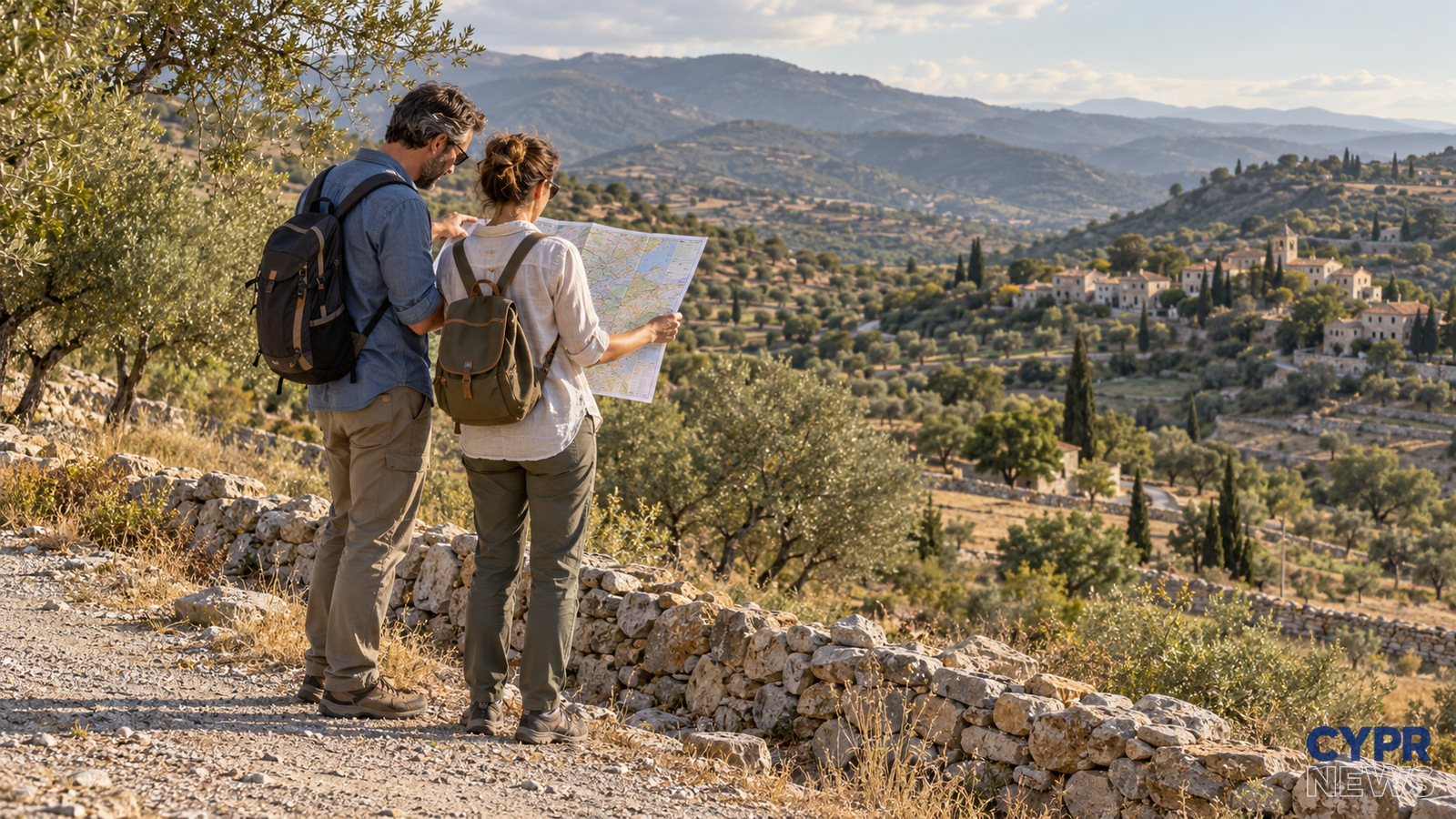
Unique places in Cyprus can be found in the mountains and small villages, as well as in the center of Nicosia. An old village fountain, glass sculptures, rock formations associated with robber tales, and a seaside cave with fossils show a different side of the island.
We've selected ten places to include in your visit. However, not all attractions have a designated entrance and parking. Some are just a short walk away, while others require prior inspection of access and site conditions.
In the Paphos district, in the Diarizos River valley, lie the massive rock formations known as Hassampoulia. It's worth seeking them out in the area between Mamonia and Kidasi, when venturing inland from Kouklia.
The place is associated with tales of robber brothers who allegedly used the rocky narrows to ambush travelers. This is part of local lore, adding further context to the landscape.
The formations alone are reason enough to stop while driving through the valley. However, cars should be parked off the road, in a safe place. Exploring the rock formations doesn't require climbing.
The Cave of the Forty Saints, or Agioi Saranta, is located on a rocky coast near Xylofagou. Fossilized hippopotamus bones have been discovered within it.
This is an interesting combination of a local religious name and the island's natural history. However, not all stories about the name's origins should be equated with scientifically proven findings.
More important is the issue of access: the surrounding caves are located on steep cliffs, and regional tourist information describes access to the sea caves from the sea. This doesn't suggest climbing down the cliffs on your own.
Let's not confuse this place with the Agioi Saranta cave church in the Protaras area - that's a different attraction.
Lageia, also known as Lagia, lies in the mountainous part of the Larnaca district. It can be included in trips to the areas around Lefkara, Vavla, and Ora.
One of the characteristic places in the village is Palaia Vrisi, an old stone fountain dating back to 1709It belonged to a system of water sources and collection points serving residents.
This is a small monument to everyday life. Instead of a monumental structure, we will see a place reminding us how important access to water was before it was brought to homes.
The fountain's historical purpose doesn't confirm its suitability for drinking today. Let's take our own water with us for a walk.
West of Agia Napa, in the coastal part of Sotira, lies the area of Agia Thekla. Next to the white chapel, you can see an older place of worship carved into the rock.
It's sometimes called a catacomb, but don't imagine a vast underground complex. It's a small space whose religious significance distinguishes it from an ordinary seaside grotto.
A visit can be combined with a walk along the coast. It's worth respecting the nature of the site and paying attention to the uneven, sometimes slippery ground.
There is no need to assign a specific date of construction or a specific archaeological function to it if they are not confirmed by information on site.
Not all unusual places in Cyprus require a trip outside the city. In Nicosia, a glass sculpture is worth a stop. "Poet", also known as Glass Man.
The work of Costas Varotsos was created in 1983The artist used layers of glass to create a figure whose appearance changes depending on the light and viewing angle.
Older guides point to the Famagusta Gate. However, the sculpture has been moved and is located at Davila Bastion, above Eleftherias Square, next to the former town hall.
It's a good stop on a walk through the city center. "The Poet" was written earlier than the famous Athenian "The Runner" by the same artist.
Select a number on the map or a place in the list to see a description.
Varotsos's second work is located near the former central offices of Laiki Bank, on Athalassas Avenue in Strovolos, near the Kalispera intersection.
Sculpture "Anelixis", also mentioned as "Anelixi II", was ordered in 1995. It has about 12 meters high and combines glass with stainless steel.
Its diagonal, spiral form evokes movement and development. It's worth examining it from several angles, as the arrangement of glass elements looks different up close and from a distance.
This stop is in a busy part of the city. It's best to walk from the legal parking spot rather than park at the intersection.
Mammari in the Nicosia district was famous for the extraction of a stone called pouropetraThe remains of mining operations are sometimes described as caves, even though they are spaces created by human activity.
Local stone was used to build houses, churches, and bell towers. The Vounaros quarry operated from 1920 to 1970.
The area is also an important bat habitat and is protected by Natura 2000. It is therefore not a place for free underground exploration.
It's best to consider Mammari as a stopover connected to the mining history and landscape. Before approaching the former workings, check the access regulations with local authorities.
In Moutoullas, in the mountain valley of Marathasa, there is a route "The Baths of the Queen and Chlio". It leads near the Setrachos River and the springs of sulfurous waters.
The name of the Queen's Baths is linked to the legend of Rigaina, who supposedly came here to bathe during the Frankish period. This story is passed down as local tradition, not a confirmed record of a visit by a specific monarch.
The regional tourist website describes the basic loop as a route of approximately 1.5 kilometers, scheduled for approximately one hour.
This is a proposal for a natural and historical walk, not a functioning thermal bath or spa facility.
Chlio is on the same route as the Queen's Baths, so both can be seen in a single excursion from Moutoullas.
This place is associated with the daily work of women who came to the water to wash their clothes. The name is associated with the lukewarm water flowing from the springs.
It's stops like these that allow us to see history beyond the confines of castles and monasteries. They tell the story of ordinary duties, meetings, and the organization of life in a mountain village.
There's no need to plan a separate journey. Just consider Chlio when walking the trail and read the information boards.
In the area Reksimo in Phini, on the Diarizos River, there are dripstone formations described on the town's website as stalactites.
Local materials mention small caves, tiny tubular formations, and reddish discoloration. However, don't expect a tourist cave with a well-lit trail.
Before leaving, it's best to ask in the town about the current access conditions and how to get there. This isn't a place you'd want to randomly descend down a steep riverbank.
We don't touch or break off the formations. Phini can be combined with learning about the local pottery tradition or other stops in the Troodos area.
It's best to choose one region and combine two or three stops. Moutoullas offers a ready-made idea for a walking tour, Nicosia for a tour of urban art, and the Diarizos Valley for a drive through the less urbanized part of the Paphos district.
For caves, quarries, and river formations, it's crucial to check access. The presence of a site in a guidebook doesn't mean there's a prepared path leading to it or that entry is permitted.
Cyprus's unique places are best discovered at a leisurely pace. Sometimes, all it takes is a detour from the main street, a stop at an old fountain, or a closer look at a sculpture you pass on your next visit to the capital.