Supported by


For centuries, the kingdoms of Cyprus shaped the political map of the island. Salamis, Paphos, Kition, and Kourion had their own rulers and territories under their control. Some even minted their own coins. Traveling between today's archaeological sites, we thus travel between former centers of royal power.
However, these states were not permanently independent from the outside world. Cypriot kings were subject to larger powers at various times, while retaining their local thrones. The borders and number of kingdoms also changed—there was no single map that applied throughout antiquity.
The term "city-kingdom" may suggest a small settlement surrounded by walls. In reality, the monarch's authority extended over surrounding communities and lands.
Farmland, access to raw materials, trade routes, and—in the case of coastal centers—ports were all important. Not every kingdom was located on the sea, and therefore not all of them built their position in the same way.
The University of Edinburgh, in its description of the history of Cypriot coinage, cites the testimony of Diodorus. According to the ancient author, in the mid-4th century BC, there were nine significant cities on the island, each with its own king and subordinate communities. Their monarchs were also dependent on the king of Persia.
A local monarchy and imperial overlordship could exist simultaneously. The ruler retained the throne but had to consider the interests of the stronger power.
Cyprus was within the sphere of influence of Assyria, Egypt, and Persia. This dependence may have involved tribute and the provision of military forces, including ships.
Therefore, it is difficult to describe the island's history by a simple division into periods of complete freedom and complete subordination. The extent of autonomy of individual centers changed with the political situation.
The names of the kingdoms aren't confined to textbooks. Some are well known to visitors to Cyprus, although modern towns and sites aren't always located exactly within the same boundaries as the ancient centers.
It is particularly important to distinguish ancient Palaipafos from the present-day city of Paphos. The former center associated with the sanctuary of Aphrodite was located in the Kouklia area.
| The former center | Where to look for him today? |
|---|---|
| Kition | Larnaca |
| Palaipafos | Kouklia, in the Paphos region |
| Idalion | The area of modern Dali |
| Marion | Polis Chrysochous |
| Kourion | West of Limassol, near Episkopi |
| Amathous | East of Limassol city center |
These are examples of locations, not a complete list of kingdoms. Their borders and status changed over the centuries.
Cyprus was the point of contact between the Greek world, the Levant, and Egypt. It did not constitute a culturally unified space.
Greek language and traditions were present in many centers. Phoenicians also played an important role, particularly associated with Kition. Amathous, however, retained distinct local traditions, including the language now known as Eteocypriot.
Traces of these contacts can be seen in monuments, inscriptions, and art. Similar motifs appeared in various kingdoms, although this did not imply a common administration or a single monarch.
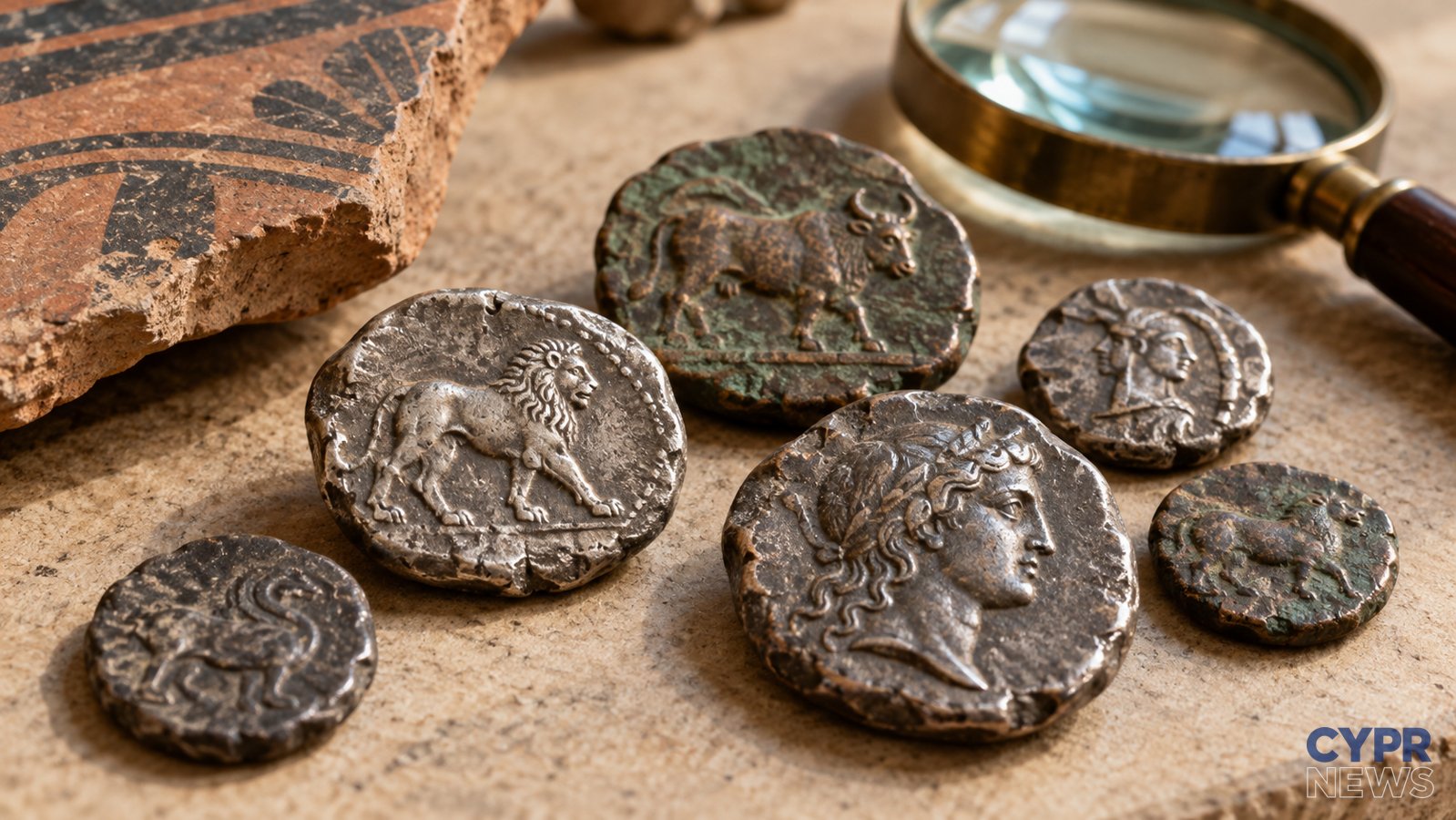
Some Cypriot kings issued their own coins. The names, inscriptions, and depictions on them serve as a source of knowledge about local dynasties today.
Coins can help determine who held power, what symbols they used, and what center they associated their rule with. Researchers compare such finds with inscriptions and accounts by ancient authors.
However, we should not assume that every kingdom left an equally rich record. Our knowledge of individual centers is uneven.
After Alexander the Great's death in 323 BC, his successors vied for the division of the empire. Cyprus, due to its location and resources, became a key focus of this struggle.
Local rulers became involved in various conflicts, which ended tragically for some dynasties. By the end of the 4th century BC, the system of local monarchies was abolished.
This process should not be identified with a one-time, peaceful unification of the island. Only in 294 BC Ptolemy I regained control of all of Cyprus, which became part of the Ptolemaic Empire.
When visiting archaeological sites, it's worth remembering that the buildings visible today often date from different eras. A theater or Roman residence may not necessarily be monuments from the time of local kings.
However, the centers themselves have a much longer history. Before they became ruins, tourist attractions, or parts of modern cities, they were places where decisions about trade, alliances, and war were made.
Sources: Cyprus Numismatic Project, The Metropolitan Museum of Art, Visit Cyprus, Leventis Museum.
AI illustration - coins are symbolic visualizations, not photographs of authentic exhibits.