Supported by


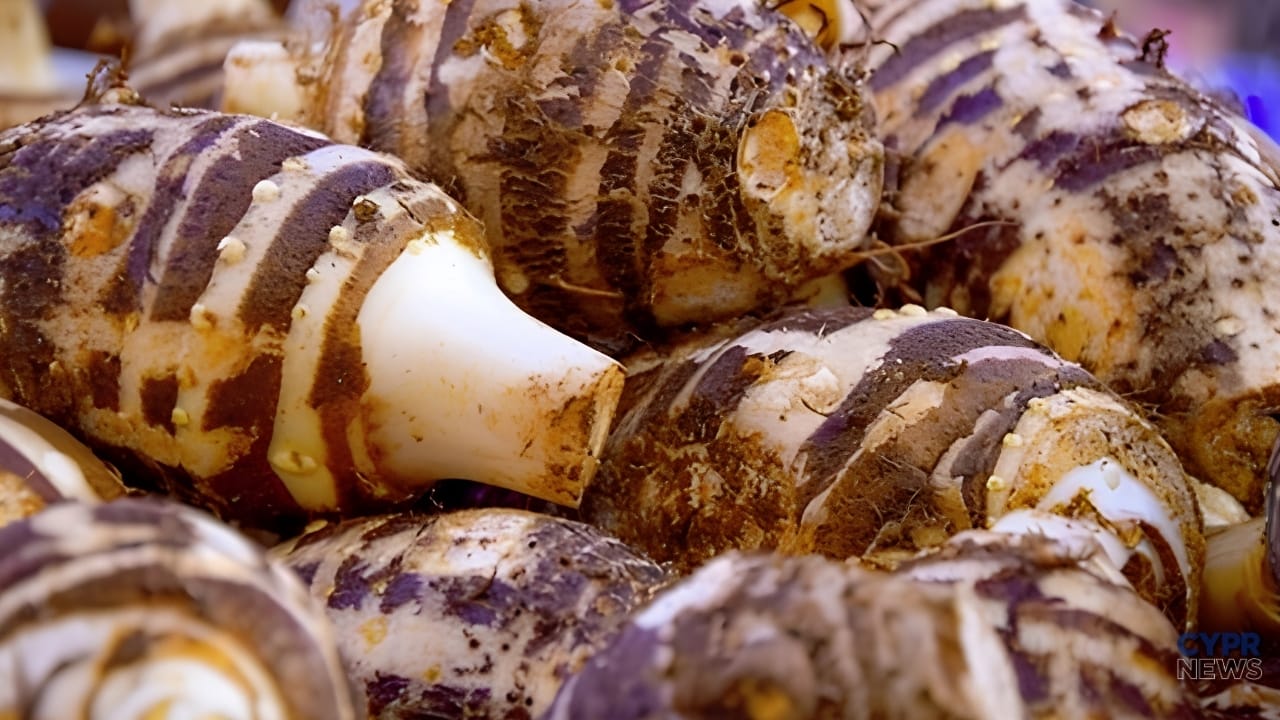
Kolokasi in Cyprus It may look like an oversized, unattractive potato. Beneath its thick, brown skin, however, lies one of the products most closely associated with local cuisine. The oldest known mention of its presence on the island dates back to 1191, and the wedding of Richard the Lionheart and Berengaria of Navarre.
Currently, kolokasi is grown primarily in the southeastern part of the island – in the areas of Sotira, Avgorou, Frenaros, and Liopetri. The harvest season begins in September and can last until May. The Sotira product has been designated a Protected Designation of Origin by the European Union.
Kolokasi is an edible colocasia, i.e. Colocasia esculentaThe plant belongs to the Arum family and is also known as taro in many parts of the world.
Its starchy underground parts are used in cooking. Although they are commonly called roots or tubers, botanically they are primarily corms, the thickened underground parts of the stem.
In Cypriot nomenclature the large, central part is called map, while the smaller parts growing next to it are poulles.
Kolokasi may taste similar to a potato. However, it is more compact and, when properly prepared, has a delicate, slightly nutty flavor. The variety grown in Cyprus grows larger than taro found in many other countries.
Some of the pieces you see in stores are truly huge.
The oldest known mention of kolokasi in Cyprus comes from 1191According to a story cited by the Cyprus Food Museum, the vegetable was served at a feast celebrating the wedding of Richard the Lionheart and Berengaria of Navarre.
The ceremony took place on May 12, 1191, in Limassol during the Third Crusade. Berengaria was crowned Queen of England.
Information about kolokasi comes from George Jeffery's 1926 historical work, which is cited by contemporary Cypriot institutions describing the history of the product.
We can therefore say that, according to the preserved tradition, kolokasi was eaten on the island more than 830 years agoThe plant itself was probably present here even earlier.
Historically, the plant was cultivated in various parts of Cyprus. Early sources mention Lapithos, Paphos, and the Karpasia region, among others.
Currently, the center of production is located in the southeast of the island. Sotira is most strongly associated with kolokasi, but plantations also operate in Avgorou, Frenaros, and Liopetri. Smaller quantities still come from the Paphos region.
Cultivation is favored by the fertile red soil of Kokkinochoria, local climatic conditions and the knowledge of producers passed down between generations.
Names Kolokasi Sotiras and Kolokasi-Poulles Sotiras were entered into the EU register of Protected Designations of Origin on 3 August 2016.
PDO, or Protected Designation of Origin, is one of the strongest forms of European protection for regional products. It signifies that the name is associated with a specific area, the origin of the raw material, and the production method.
Kolokasi was the first Cypriot product to receive PDO protection. Previously, other Cypriot products, such as loukoumi from Geroskipou, had received different geographical indications.
The traditional method of preparation is very characteristic.
Once peeled, the kolokasi is not cut into even cubes. The tip of a strong knife is inserted into the surface and then an irregular piece is broken off.
This technique leaves a rough surface, allowing the pieces to better bind with the thick sauce during stewing.
Cypriot recipes recommend that after peeling, the product should be cleaned with a damp cloth rather than rinsed under running water. However, different families use different preparation methods.
Lemon is usually added at the end of cooking. Adding the acidic ingredient too early can cause the kolokasi to remain tough.
One of the most popular Cypriot methods is to stew kolokasi with meat, tomatoes and celery.
The official Visit Cyprus recipe uses pork, tomatoes, red wine, cinnamon, celery, and lemon juice added at the end of cooking. Meatless versions are also available.
In the Ammochostos region it is popular kolokasi kappamas, cooked with wine. The vegetable can also be fried, prepared as chips, or made into a purée.
Traditional recipes vary depending on the locality and family. Some chefs add more tomatoes, others emphasize the flavor of celery or wine. There is no single recipe that applies to every Cypriot home.
Watch more short films about Cyprus, its flavors, traditions, and everyday life.
 VISIT OUR CHANNEL
Kolokasi don't always need to be dug up immediately after they reach maturity. They can remain in the ground for some time and only be harvested when needed.
For this reason, farmers called them "koukoumas", i.e. piggy banks.
This had very practical implications. Instead of harvesting the entire crop at once and finding a place to store it, some could be left in the field.
The land became a natural storehouse, and the producer could dig up kolokasi whenever a buyer appeared or the family needed food.
The plant is typically planted from late February to April. It is ready for harvest when the leaves begin to naturally yellow and die.
The season usually starts at the beginning of September and lasts until MayThe long period is due, among other things, to the possibility of leaving part of the crop in the ground.
Autumn is therefore a good time to look out for kolokasi in supermarkets, greengrocers, and local markets. This is when the harvest begins, and events dedicated to this vegetable are organized in the producing regions.
On the store shelf, kolokasi doesn't look particularly impressive. They're large, brown, and irregular. It's easy to walk right past them and reach for the familiar potatoes.
The history of this product, however, includes a medieval feast, centuries-old cultivation, family recipes and modern European protection of origin.
The next time we see a huge bronze tuber in a Cypriot shop, it's worth remembering that a similar kolokasi may have been on the table at a royal wedding in Limassol more than eight centuries ago.
Sources: Department of Agriculture of the Republic of Cyprus, Deputy Ministry of Tourism – Visit Cyprus, Cyprus Food Museum, European Commission.