Supported by


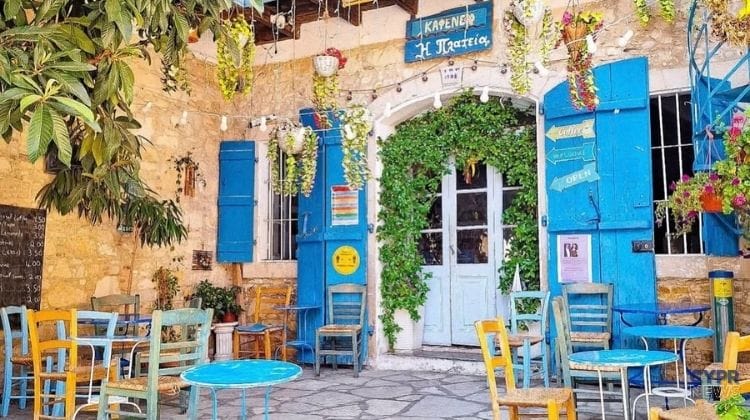
Kafenio in Cyprus From the outside, it may look like an ordinary, small café. A few tables, simple chairs, small cups of strong coffee, and the distinctive clatter of tavli cubes. For decades, however, such places served a much more important function: they were one of the centers of daily life for the local community.
Today, you can walk into a kafenio for a coffee, relax, and chat with the locals. In the past, these same tables were where news was exchanged, deals were made, politics was discussed, village life was organized, and information was shared, before radio, television, and the internet reached every home.
The official tourism project Heartland of Legends describes the kafenio as an important part of everyday life. It's a place for people to meet, play tavli and cards, discuss the day's events, and serve as a natural stopover for those passing through the village.
In a traditional village, a kafenio was often located near the central square. It didn't need flashy décor. A few tables and chairs were sufficient, because the most important thing wasn't the interior, but the people who regularly met there.
It was there that one could find out what had happened to a neighbor, who had returned from town, who was planning a wedding, or what decisions had been made regarding matters affecting the entire community.
Research into the culture of traditional cafés shows the wide range of functions such places once served.
Aspasia Papadima of the Cyprus University of Technology, who has researched Cypriot coffeehouse culture, points out that, especially in rural areas, the kafenio may have been a place for commercial transactions and contracts. Family matters, including marriages and dowries, were also negotiated there.
Coffeehouses also served functions we now associate with entirely different institutions. In some places, they served as mail collection points or tax collection points. Before them, artisans and farmers sold their products.
Kafenio was therefore not only a place to relax after work.
It was a local information and service center.
In times when not everyone could read and access to information was limited, one newspaper could serve many people.
According to Papadima's research, news in the kafenio was spread through radio and newspapers, among other media. A newspaper might be read aloud by a more educated resident, a teacher, or a local priest. In this way, information reached the entire group of people gathered at the tables.
Over time, radio appeared, then television, and today everyone has news on their phone.
Despite this, the need to talk about what had just happened remained essentially the same.
It's worth knowing
Research into the history of coffeehouses in Cyprus indicates that their existence can be documented as early as the 17th century. In the 19th century, foreign travelers visiting the island also described the customs associated with local coffeehouses.
It's hard to imagine Kafenio without games.
One of the most iconic remains tavli. Pilot, a locally popular card game, also appears alongside it. Heartland of Legends even depicts the typical image of a grandfather teaching his grandson tricks at the board, while observers stand by, commenting on the moves and offering advice.
This is why tavli and kafenio go so well together.
The game gives you an excuse to sit down.
Coffee allows you to stay a little longer.
And the conversation means that two hours can pass almost unnoticed.
Cypriot coffee is made from very finely ground beans. It is boiled with water in a small, long-handled vessel called mbriki. Traditionally, they were made of copper.
The key moment in preparation occurs just before boiling. A characteristic ripple should form on the surface. kaimaki, i.e. a layer of foam.
You can order coffee in three basic ways:
skete – sugar free,
metro – medium sweet,
Glyki - sweet.
It is usually served in a small cup with a glass of water. The sediment remaining at the bottom should not be drunk.
Not every element of this tradition looks equally romantic today.
For much of its history, the classic kafenio was a male-dominated space. Research into the culture of these spaces shows that this was linked to the ancient division of social roles and the way women and men understood access to leisure time and public space.
This is also changing.
Modern establishments often retain the name, coffee, tavli, and atmosphere of the old kafenio, but are much more open. Tradition doesn't disappear entirely—rather, it adapts to modern life.
A good example of the continuity of this tradition is "O Prodromos" in Kaimakli, Nicosia.
The Cyprus University of Technology Digital Archives tells the story of Prodromos and Christina Kazamia. In 1949, they converted two rooms in their home into a traditional kafenio and a small grocery store. Christina ran the business while working as a seamstress and raising her children.
According to the archives, the kafenio is still operating today.
One small café can therefore survive subsequent generations, enormous social changes, the emergence of television, the internet, smartphones and chain cafés.
And still serve people exactly what they came there for decades earlier.
Coffee and the opportunity to meet other people.
This perhaps best explains why the kafenio is still such a characteristic feature of Cypriot villages.
You can make coffee at home.
Tavli can also be placed on your own table.
But the kafenio was always something more – a place where the private lives of its inhabitants met the life of the entire community.
Today, its role is smaller than before, but it is enough to sit at a table in a quiet village, order a metro and listen to the conversations around you for a while.
It is then easy to understand that the most important product of kafenio has never been coffee.
It was meeting.
The material was prepared based on information from the Deputy Ministry of Tourism, the Heartland of Legends project, the Cyprus University of Technology and research on the culture of traditional coffee houses in Cyprus.